Humans Need Not Apply by Jerry Kaplan is a provocative and sobering examination of the effects that automation and artificial intelligence (AI) will have on the distribution of wealth and the global workforce. Kaplan explores the moral, financial, and societal ramifications of an AI-driven future in a book that is both readable and rigorously academic. The book is worthwhile reading for anyone interested in the ramifications of this quickly developing technology since, whilst not avoiding the technical parts of AI, it is nonetheless understandable to those without a background in computer science.
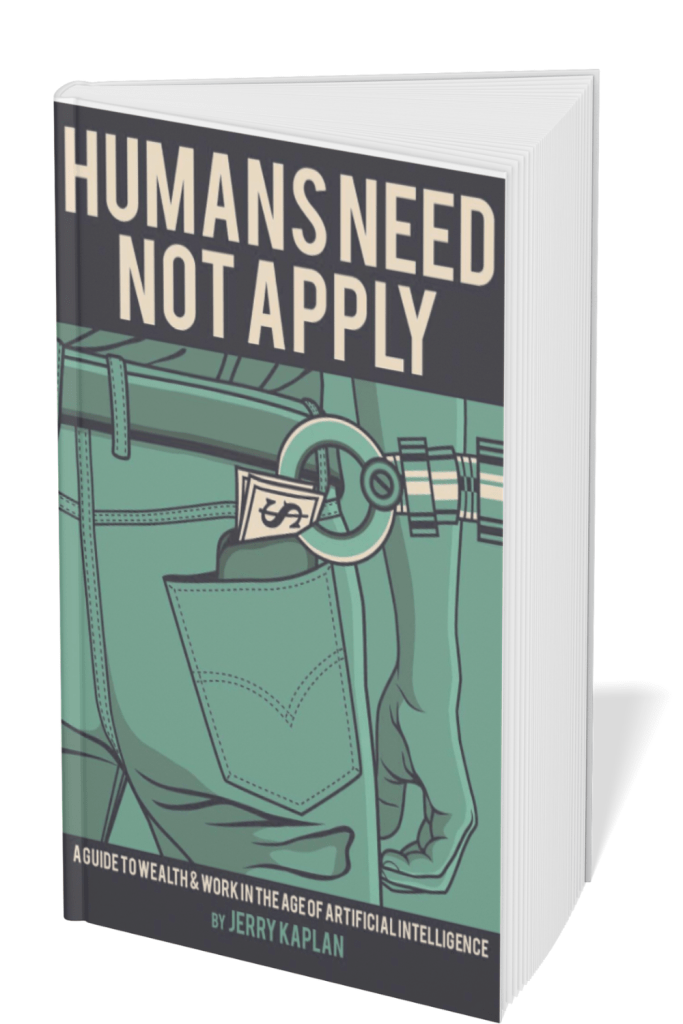
Cover Image: amazon.com
Kaplan’s main contention is that developments in AI have the potential to drastically change the nature of labor and, consequently, society at large. Kaplan claims that this wave of automation is distinct from earlier technological revolutions, which created new employment while old ones vanished. AI systems can perform better than humans in cognitive domains like pattern recognition, decision-making, and even creative processes, in addition to repetitive, mechanical jobs.
Kaplan’s argument is straightforward: white-collar occupations like law, medicine, and finance will also be impacted by job automation, not just blue-collar people. Kaplan warns of a dystopian future if we ignore the resultant income disparities and the possible loss of purpose for displaced workers, even though this transition could lead to large productivity improvements and economic growth.
Kaplan’s ability to focus on the difficulties presented by AI while keeping his analysis rooted in historical context is one of his strong points. He draws comparisons between the Industrial Revolution and the AI revolution, but he makes sure to highlight the contrasts, especially about the rate of change and the possible extent of job displacement.
The theoretical foundations of artificial intelligence, such as robots and machine learning, are also explained in an interesting and understandable manner by Kaplan, who also skillfully ties these ideas to practical uses. For instance, it’s both enlightening and unnerving to hear him talk about self-driving cars and how they might upend the transportation sector.
Kaplan’s recommendations for policies to manage this transition are another standout feature of the book. These include investigating alternate models of wealth distribution, such universal basic income, and implementing a “job mortgage” system to finance retraining and lifelong learning. Even if some of his concepts might appear radical, they are supported by sound logic and a sincere concern for humanity’s long-term well-being.
Humans Need Not Apply has certain drawbacks despite its many advantages. Kaplan’s explanation of the inevitable widespread unemployment might occasionally come out as unduly negative, bordering on fatalistic. Although he admits that AI may lead to new markets and opportunities, his cautions about societal disruption frequently outweigh these prospects.
Furthermore, despite their inventiveness, Kaplan’s policy suggestions occasionally lack specifics for their actual execution. Given the divisive political environment of today, readers may ask how such ambitious reforms may be implemented in a practical manner. For instance, given the strong corporate and political opposition, his support for wealth redistribution and automation taxes may appear to be wishful thinking.
Anyone interested in comprehending the profound changes that artificial intelligence and automation will bring to the global workforce and economy should read Kaplan’s Humans Need Not Apply. It urges society to face these issues with compassion, ingenuity, and foresight, acting as a wake-up call as well as a manual. Even if some of Kaplan’s projections might seem bleak, his hope for a fair and cooperative future is evident in the solutions he suggests.
In the end, the book poses important queries regarding the place of people in a world where machines are taking over. When work as we know it can disappear, how do we determine meaning and purpose? How do we make sure that the advantages of AI are distributed rather than making already-existing disparities worse? Although Kaplan doesn’t profess to know everything, his book is a great place to start these important discussions.
 MACIJI