Vetements, the French fashion collective founded in 2014 by Demna and Guram Gvasalia, has reshaped the boundaries of fashion through its radical reinvention of streetwear and subcultural codes. With its roots in irony, anonymity, and the aesthetics of the everyday, Vetements has become synonymous with disruption—turning the mundane into the monumental. A key but often underestimated facet of Vetements’ effect is the importance of photography, not just in its ads, but in the fundamental essence of its design philosophy.
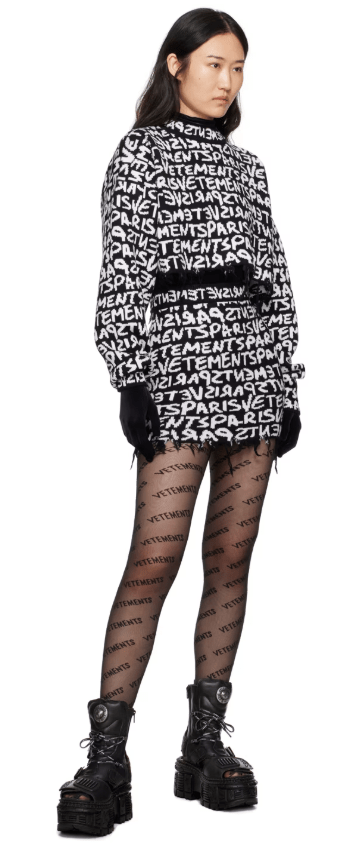
Image Source: https://www.ssense.com/fr-fr/femmes/produit/vetements/pull-noir-et-blanc-a-logos-en-intarsia/16266221
A Look at Fashion
Fashion has always relied heavily on photography, but Vetements employs it in a special way, integrating it into the cultural memory rather than just documenting apparel. The brand uses photography in a reflective way rather than a passive one. Vetements is aware that in the era of Instagram, surveillance, and extreme visibility, apparel needs to be seen via the lens as well as on the runway.
Gay bars, Chinese eateries, and department store basements were among the unusual settings where the label frequently displayed its early collections; these locations were picked for their photographic atmosphere as much as their cultural importance. These areas served as living picture locations, showcasing the clothing in authentic settings that complemented the brand’s anti-glamour message. In keeping with the raw reality of photographers like Nan Goldin or Juergen Teller, lookbooks and campaign photography were often photographed in documentary techniques. The end effect was a visual language that was raw, voyeuristic, and urgent, and it complemented Vetements’ provocative clothing brilliantly.
Clothes as Subjects for Photography
Vetements incorporates photography into its design in addition to using it as documentation. Photographic prints, paparazzi images, or screen-grabbed images that resemble surveillance footage or tabloid aesthetics have been used on t-shirts, hoodies, and coats. The use of celebrity-style graphics and phoney DHL branding, which criticises consumerism and our fixation with media spectacle and celebrity, is among the most famous examples.
These photography prints offer commentary in addition to decoration. They distort the perception of fashion onto the actual fashion. By doing this, Vetements blurs the lines between the wearer and the viewer, the clothing and the screen, reflecting the way that cameras, phones, and continual visual mediation are used in modern life.
Using the Screen to Influence the Street
Vetements’ impact on street style is inextricably linked to the way it is photographed. Its clothing frequently has enormous silhouettes, striking logos, and dramatic deconstruction that convey attitude and movement in a single shot, giving the impression that it was designed with photography in mind. In digital culture, where clothing is consumed more often through computers than in person, the brand’s visual identity flourishes.
Vetements uses photography as a means of communication, criticism, and marketing. It’s no accident that many of its pieces “go viral”—not because they’re aesthetically pleasing in the traditional sense, but rather because they spark online debate, memeification, or reaction—all of which are important currency in the digital fashion ecosystem.
Photography is not an afterthought in Vetements’ world; rather, it is a physical and symbolic element of everything. Vetements makes apparel that is as compelling in the picture as it is on the body by fusing the aesthetics of social media, paparazzi culture, and street photography with high fashion. Vetements is aware that to design for fashion is to design for the frame in an era where the picture can be more important than the runway.
It has also reframed fashion itself in the process.
 MACIJI